
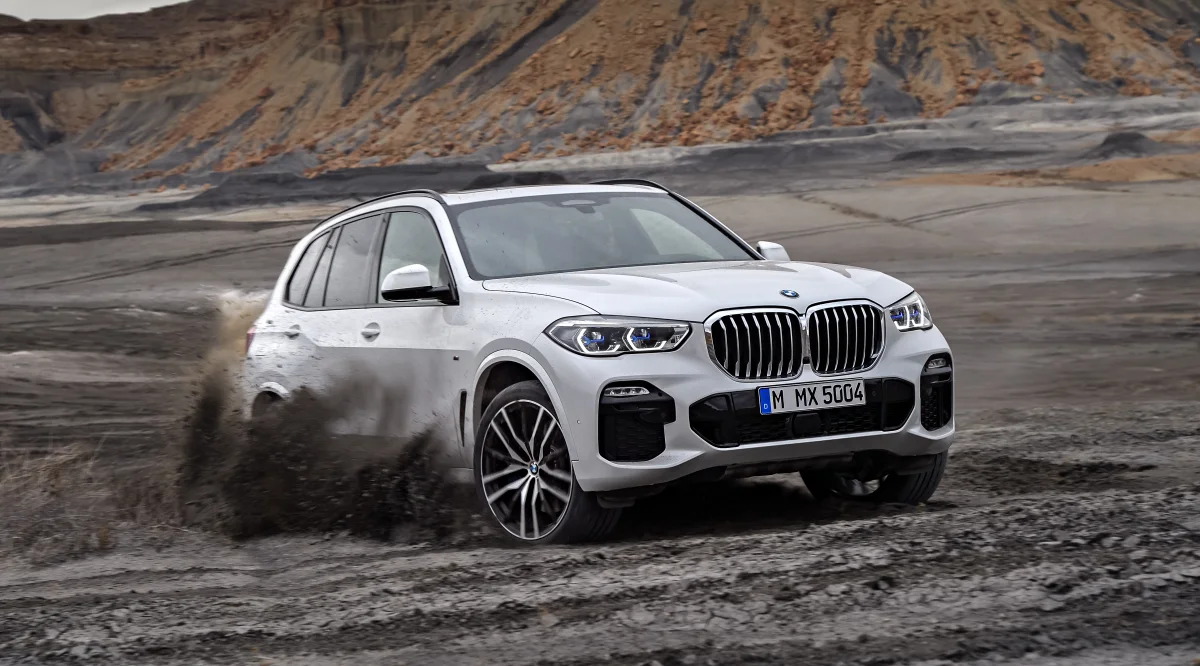
BeEmVee wroteWouldn’t be going for the M-Sport - in anything other than black the front area looks absolutely atrocious in my opinion- pre LCI the M-Sport looked awesomeNot sure if you’re aware, but you will only be able to select the standard design in the 40i and not M Sport if you opt for the air suspension. Just something to weigh aesthetics vs features.
36.9KVIEWS
176REPLIES
180APPRECIATES
68ACTIVE PEOPLE
10 hours agoLAST POST
BlkGS wrotethis is where you misunderstand air suspension. it’s not like an air mattress at all as you described as that is a linear way of thinking. it’s much more complicated than that.TurtleBoy wroteThat's not how air springs work. It's like an air mattress, if you fill it up less, it's softer and doesn't fill up all the way. If you fill it up all the way, the mattress is taller, and stiffer.That is not the away the air suspension works as it is progressive. The spring rate actually increases as the ride is lowered. That is one of the reasons why Sport mode lowers the vehicle.
You cannot make a volume of air stiffer when it's at a lower pressure. That's not how air pressure works.
“There are 4 key components (out of many) that affect the driving dynamics of the 2-axle air suspension: Closed 2-axle air suspension system, Driving Dynamics Modes, Electronic Damper Control (EDC) and Vertical Dynamic Platform (VDP).
When the vehicle lowers, damping is increased, but the effective spring also increases.
By lowering the vehicle, the volume of air available for compression is reduced. A given suspension displacement in compression will, therefore, have a greater degree or percentage of compression of this air volume resulting in a greater pressure rise which, in turn, results in a greater reacting force; i.e. an increased effective spring rate.”
PunsGalore wroteGreat you’re aware. It is a big hunk of glossy black on the front I agree. Looks better in person at eye level than ground level photos. Personally, I didn’t want the matte plastic bumpers and wheel arches which can stain chalky white from environmental factors, and I liked the extended body panels as well as smooth leather steering wheel of M Sport. The rear view really hooked me in. That’s why they offer two variants! Definitely go w air suspension in your case; smooths out road imperfections very well and there is only a slight loss in handling.Wouldn’t be going for the M-Sport - in anything other than black the front area looks absolutely atrocious in my opinion- pre LCI the M-Sport looked awesome
1) I’ve never had air suspension problems before 100k miles, at which point a regular suspension would have needed to be replaced anyway.
2) Air suspensions generally work the same over their whole lifetime—their performance usually doesn’t change unless something breaks.
3) For some reason the dealers really like to gouge on air suspension repairs. My kid’s old Land Rover made it to 140k miles before any problems, solved for $400 at my independent mechanic. The dealer would have wanted $4k.
Honestly, the air suspension option is the least scary thing about owning a car that’s otherwise this complicated.
nZtiZia wroteClearly the addition of adaptive shocks helps offset this some. You can increase you shock damping to approximate a stiffer spring.this is where you misunderstand air suspension. it’s not like an air mattress at all as you described as that is a linear way of thinking. it’s much more complicated than that.
“There are 4 key components (out of many) that affect the driving dynamics of the 2-axle air suspension: Closed 2-axle air suspension system, Driving Dynamics Modes, Electronic Damper Control (EDC) and Vertical Dynamic Platform (VDP).
When the vehicle lowers, damping is increased, but the effective spring also increases.
By lowering the vehicle, the volume of air available for compression is reduced. A given suspension displacement in compression will, therefore, have a greater degree or percentage of compression of this air volume resulting in a greater pressure rise which, in turn, results in a greater reacting force; i.e. an increased effective spring rate.”
Y'all are doing a lot of mental gymnastics to convince yourself.of something that is flat out wrong.
To simplify from a company that SELLS AIR SPRINGS.
Source: https://airride.co.uk/air-suspension-explained/The advantage to the air bag is that it has a variable spring rate – the more air you pump in, the higher its spring rate. Thus, by inflating the bag you can take the spring rate from 0lb/inch (with no air) to as much as 600lb/inch at maximum pressure (about 200 PSI (pounds per square inch)).
There's literally tons of other sites explaining this as well.
BlkGS wroteYou can believe what you want but that is false in regards to the way progressive air suspensions work.Clearly the addition of adaptive shocks helps offset this some. You can increase you shock damping to approximate a stiffer spring.
Y'all are doing a lot of mental gymnastics to convince yourself.of something that is flat out wrong.
To simplify from a company that SELLS AIR SPRINGS.
Source: https://airride.co.uk/air-suspension-explained/
There's literally tons of other sites explaining this as well.

"Most air springs are progressive. The more they compress, the stiffer they get. Combine this inherent progressive spring rate with in-car adjustability, and the result is enormous performance potential."
https://www.motortrend.com/how-to/hrdp-0701-air-suspension/
"At the core of any air suspension system is its bags, or air springs. Here, rubber bellows that feature metal plates at each end slip over the shocks, similar to a coil spring. Like coil springs, air springs are progressive in nature, which means increased compression results in a stiffer spring. "
https://www.motortrend.com/how-to/1506-air-suspension-how-it-works/
"By adjusting the air, the Praxis system can vary the ride height and consequently the spring rate. Removing air decreases the volume of the bladder, lowers the car, and as a result, makes the spring stiffer."
https://www.caranddriver.com/features/a18202385/praxis-air-suspension-feature/
https://www.tirerack.com/images/suspension/praxis/pdf/0311_scc_prax1.pdf
The sport lowering is actually minimal, it is so little that it does feel like it has the same spring rate as the normal setting, the advantage for sporty driving is a little lower center of gravity, that always helps to take a fast turn.
I do not feel much lean into the corners either, but I do have to watch out for the weight transfer reaction as it is a tall SAV.
tooloud10 wroteThey have that reputation because they are less reliable. They leak, the lines leak, the compressors fail, ride height sensors fail... Steel springs basically don't fail. Maybe in some rust hell, but if your springs Have rusted to failure, the rest of the car.likely rusted away long ago.Can we dispel with the notion that air suspensions are somehow less reliable or wear out quicker than a standard steel suspension?
1) I’ve never had air suspension problems before 100k miles, at which point a regular suspension would have needed to be replaced anyway.
2) Air suspensions generally work the same over their whole lifetime—their performance usually doesn’t change unless something breaks.
3) For some reason the dealers really like to gouge on air suspension repairs. My kid’s old Land Rover made it to 140k miles before any problems, solved for $400 at my independent mechanic. The dealer would have wanted $4k.
Honestly, the air suspension option is the least scary thing about owning a car that’s otherwise this complicated.
TurtleBoy wrote...
"At the core of any air suspension system is its bags, or air springs. Here, rubber bellows that feature metal plates at each end slip over the shocks, similar to a coil spring. Like coil springs, air springs are progressive in nature, which means increased compression results in a stiffer spring. "
 BlkGS
BlkGSwe understand and agree with the physics behind it, but your basic understanding (while accurate) is limiting your comprehension of the air suspension system. it's not just simply like inflating or deflating air inside a mattress (to use your analogy).
when the vehicle is lowered, you think it's just the bags deflating like that article you linked stated. it's not. a certain amount of pressure needs to be maintained or else the vehicle will bottom out. this is where compression comes into play. when air is compressed, it's 'stiffer'. here's how another member explained it:
"Well, I don't think it's that simple. We can't use a tire or balloon [or mattress] analogy here. In something like a tire, lower pressure supporting the same weight requires the tire to spread out. That way lower psi has more square inches of area supporting the same weight.
The air suspension on our cars is significantly more restrictive in manner of "ballooning" with pressure changes. Think of it this way - suppose I want to support 1,000 lbs on a hydraulic jack, and I can choose to do so at 6" or 12" of height. In this admittedly extreme example, there is zero "ballooning," and therefore the height is strictly based on the volume of fluid pumped under the piston. The pressure of that fluid, at our example weight, will be exactly the same at 6" or 12" because the supported weight and the piston area supporting that weight are static. We just have more fluid in there.
While the suspension on our cars has some flexibility, it is substantially restricted compared to something like a tire or balloon. The area in sq inches the air can act on to support the weight doesn't materially vary at different heights. Lower the car 2", and you have reduced the static air volume in the bag via the control valve, but the air is supporting the same weight and doing so over "mostly" the same area. In other words, it's not restrictive like a jack cylinder would be, but it's not anything like a tire or balloon that can disburse our given weight over a much larger area. The static pressure will be lower only to the extent that more surface area is available - not in total but with respect to the area supporting the vehicles weight.
Separately from that, an air suspension is rising rate. If the area is fixed, and we force the volume to decrease, the pressure will increase. Air is compressible, of course, so we have a measure of compliance. Here's the point most folks miss - if I start with 100 cu. in. of static volume, and I decrease a given amount (bump), the pressure will rise a determinable amount. We all know that. But if I started instead with only 50 cu. in. of static volume, and I decreased the volume by the same bump, then the pressure delta, the increased pressure resulting from that volume change, would be twice as much. Rising rate characteristic means each subsequent increase in compression (bump) has a much larger effect on my spring rate than had I started with a higher static volume. "Compression ratio" if you will. Our suspension volume isn't that rigid, but it is not entirely flexy/squishy. We're somewhere in between.
Again, if the air suspension had a substantial capacity to balloon out and spread that pressure delta over much more surface area, then the compressed pressure would not spike much - it would disburse over the ballooning area. We don't have that extreme flexibility, though.
The point is that lowering the suspension will have a lower static pressure, just not as much as folks might think, because the surface area remaining to hold up the same vehicle weight is not markedly greater. Same weight, not much more area to apply the pressure to support the weight = small change in the pressure, but mostly a change in the volume via the valve (my jack analogy).
Smaller static volume, compressed a given amount by a bump, will have a correspondingly greater rate increase over that compression cycle vs that with the larger beginning static volume.
Noticeably firmer ride on rough roads."
PunsGalore wroteOne word: Yes.Hi all,
I am wondering if ordering air suspension on the 25' X5 xDrive40i would be worth it? Air suspensions have always scared me a little, but open to hearing your thoughts! Will most likely go without due to cost savings and the extra piece of mind
Thanks

jad03060 wroteThat fair but the service life of a steel spring is basically infinite, whereas an air bags lifetime is not. I think a wear method where your spring rate graduated decreases miniscule amounts over many many decades is preferable.over an air spring that fails to non function in 10-15 years.A typical steel spring may not physically break very often, but they do not retain the same spring rate throughout their entire life while an air bag does…works until it fails. If you want simpler, don’t buy a BMW. With anything, the more complex it is, the more there is to break or wear out, and the cost to maintain goes up, but in routine maintenance and in replacement as things age and wear out
That said, I agree with the rest of what you said. There's a LOT of complexity on these cars and the more complexity, the more to go wrong.
nZtiZia wroteI totally understand the system. The progressive nature of it does not mean what you think it does. It means that the spring rate changes as the force applied Changes. That's why air springs ride nicely, minor impacts yield a very low spring rate, making for a cushy ride. But as you press harder against the spring, it pushes back harder to prevent a bottoming out. It does NOT mean that the same ride height creates the same spring rate independent of the nominal ride height. Meaning if you've got 32" of fender gap from your air suspension height, you wouldn't have the same spring rate as if your ride height had compressed to 32" from a nominal height of 36".
we understand and agree with the physics behind it, but your basic understanding (while accurate) is limiting your comprehension of the air suspension system. it's not just simply like inflating or deflating air inside a mattress (to use your analogy).
when the vehicle is lowered, you think it's just the bags deflating like that article you linked stated. it's not. a certain amount of pressure needs to be maintained or else the vehicle will bottom out. this is where compression comes into play. when air is compressed, it's 'stiffer'. here's how another member explained it:
"Well, I don't think it's that simple. We can't use a tire or balloon [or mattress] analogy here. In something like a tire, lower pressure supporting the same weight requires the tire to spread out. That way lower psi has more square inches of area supporting the same weight.
The air suspension on our cars is significantly more restrictive in manner of "ballooning" with pressure changes. Think of it this way - suppose I want to support 1,000 lbs on a hydraulic jack, and I can choose to do so at 6" or 12" of height. In this admittedly extreme example, there is zero "ballooning," and therefore the height is strictly based on the volume of fluid pumped under the piston. The pressure of that fluid, at our example weight, will be exactly the same at 6" or 12" because the supported weight and the piston area supporting that weight are static. We just have more fluid in there.
While the suspension on our cars has some flexibility, it is substantially restricted compared to something like a tire or balloon. The area in sq inches the air can act on to support the weight doesn't materially vary at different heights. Lower the car 2", and you have reduced the static air volume in the bag via the control valve, but the air is supporting the same weight and doing so over "mostly" the same area. In other words, it's not restrictive like a jack cylinder would be, but it's not anything like a tire or balloon that can disburse our given weight over a much larger area. The static pressure will be lower only to the extent that more surface area is available - not in total but with respect to the area supporting the vehicles weight.
Separately from that, an air suspension is rising rate. If the area is fixed, and we force the volume to decrease, the pressure will increase. Air is compressible, of course, so we have a measure of compliance. Here's the point most folks miss - if I start with 100 cu. in. of static volume, and I decrease a given amount (bump), the pressure will rise a determinable amount. We all know that. But if I started instead with only 50 cu. in. of static volume, and I decreased the volume by the same bump, then the pressure delta, the increased pressure resulting from that volume change, would be twice as much. Rising rate characteristic means each subsequent increase in compression (bump) has a much larger effect on my spring rate than had I started with a higher static volume. "Compression ratio" if you will. Our suspension volume isn't that rigid, but it is not entirely flexy/squishy. We're somewhere in between.
Again, if the air suspension had a substantial capacity to balloon out and spread that pressure delta over much more surface area, then the compressed pressure would not spike much - it would disburse over the ballooning area. We don't have that extreme flexibility, though.
The point is that lowering the suspension will have a lower static pressure, just not as much as folks might think, because the surface area remaining to hold up the same vehicle weight is not markedly greater. Same weight, not much more area to apply the pressure to support the weight = small change in the pressure, but mostly a change in the volume via the valve (my jack analogy).
Smaller static volume, compressed a given amount by a bump, will have a correspondingly greater rate increase over that compression cycle vs that with the larger beginning static volume.
Noticeably firmer ride on rough roads."
You can tell yourself whatever you want, but you're fooling yourselves. A less inflated air spring has a lower spring rate. BMW ride engineers are good (arguably the best in the industry) and will mask it with adjustments to the shock dampeners, but the air springs are not the performance option. There's a reason you don't see air ride on any serious sport cars, and that's because of the way that air springs work opposite of what you want. If air ride worked the way you think it does Porsche would be fitting it on the gt3 so that you could press a button and clear speed bumps, and then drop back down to lower ride height for performance. But they don't, because it doesn't work the way you think it does.
BlkGS wroteExcept.... that is not how it works.I totally understand the system. The progressive nature of it does not mean what you think it does. It means that the spring rate changes as the force applied Changes. That's why air springs ride nicely, minor impacts yield a very low spring rate, making for a cushy ride. But as you press harder against the spring, it pushes back harder to prevent a bottoming out. It does NOT mean that the same ride height creates the same spring rate independent of the nominal ride height. Meaning if you've got 32" of fender gap from your air suspension height, you wouldn't have the same spring rate as if your ride height had compressed to 32" from a nominal height of 36".
You can tell yourself whatever you want, but you're fooling yourselves. A less inflated air spring has a lower spring rate. BMW ride engineers are good (arguably the best in the industry) and will mask it with adjustments to the shock dampeners, but the air springs are not the performance option. There's a reason you don't see air ride on any serious sport cars, and that's because of the way that air springs work opposite of what you want. If air ride worked the way you think it does Porsche would be fitting it on the gt3 so that you could press a button and clear speed bumps, and then drop back down to lower ride height for performance. But they don't, because it doesn't work the way you think it does.
BlkGS wrotenah, you don't. you're thinking only in volume and not understanding the system adjusts pressure as well. also, it seems you fail to realize the air in these systems is compressed/pressurized whether at max height or minimum height. at minimum height, that compressed/pressurized air has even less room to 'travel' (because of less volume of space between molecules), therefore a higher spring rateI totally understand the system. The progressive nature of it does not mean what you think it does. It means that the spring rate changes as the force applied Changes. That's why air springs ride nicely, minor impacts yield a very low spring rate, making for a cushy ride. But as you press harder against the spring, it pushes back harder to prevent a bottoming out. It does NOT mean that the same ride height creates the same spring rate independent of the nominal ride height. Meaning if you've got 32" of fender gap from your air suspension height, you wouldn't have the same spring rate as if your ride height had compressed to 32" from a nominal height of 36".
You can tell yourself whatever you want, but you're fooling yourselves. A less inflated air spring has a lower spring rate. BMW ride engineers are good (arguably the best in the industry) and will mask it with adjustments to the shock dampeners, but the air springs are not the performance option. There's a reason you don't see air ride on any serious sport cars, and that's because of the way that air springs work opposite of what you want. If air ride worked the way you think it does Porsche would be fitting it on the gt3 so that you could press a button and clear speed bumps, and then drop back down to lower ride height for performance. But they don't, because it doesn't work the way you think it does.

Time out!
I just want to interject Jen’s butt o meter data into this high tech discussion.
The 2025 50e with air suspension in comfort mode FLOATS just like a Macan s/ GTS does but unlike a X3 M40i with adaptive.
Porsche has mastered the Macan suspension but for even as good as the Macan GTS is with air there’s still a slight float to it. Porsche engineer techs admit this as well. They admit that for the ultimate Macan handling, it’s steel all day long not air.
Put the big heavy 50e into a hair pin curve like I did, add in a few road imperfections and it gets floaty- period NOT sporty. It’s not horrible but it’s noticeable and not a plus.
Go drive a X3 M40i with adaptive, than an GTS and than a 50e with air back to back like I did 3 weeks ago and you tell me the air doesn’t feel floaty. The buttery soft ride with air might still be the best all around choice but the trade off is a bit of float.
Now please go back to the regularly scheduled programming and dish out your “schalacking” Turtle Boy:D
BlkGS wroteUnfortunately these three words usually mean “I have no idea about”I totally understand
It is obviuosly NOT A BAG as you would find in a semi truck. These are contained inside their own structure with a conical shape, therefore spring rate is kept in their optimal values for each use and height. It is not controlled just by adaptive shock absorber.
Does not BMW indicate that this is their most confortable suspension and possibly as capable as the standard steel suspension?
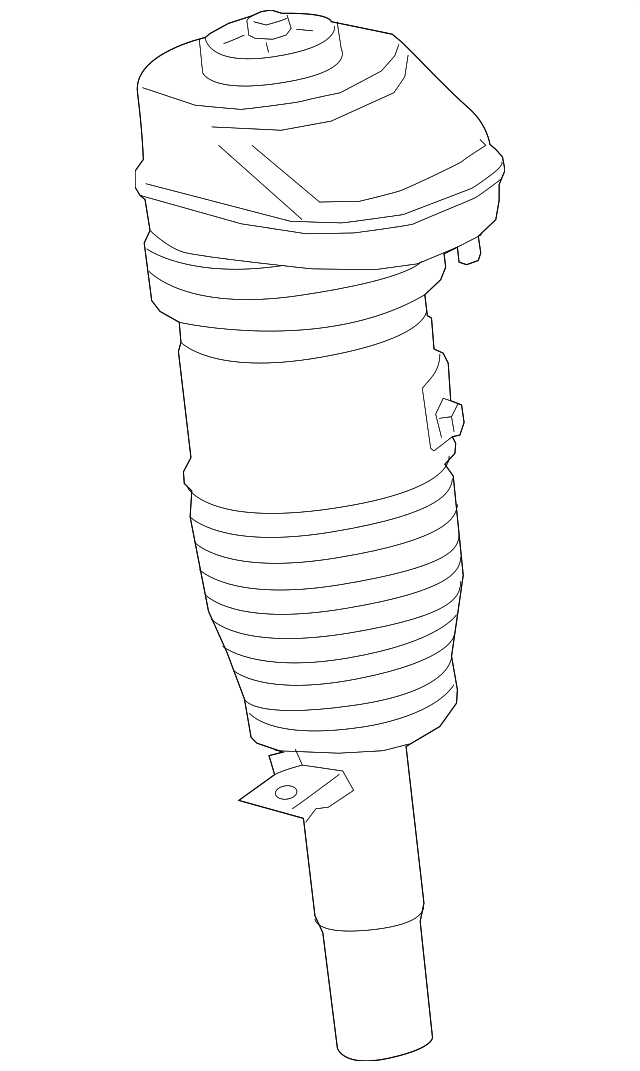
Jen4BMW wroteBut but but, the BMW sales person said the air suspension is the bestest, it rides better and is sportier and it's the best option! How could your butt o meter being feeling float that doesn't exist!?
Time out!
I just want to interject Jen’s butt o meter data into this high tech discussion.
The 2025 50e with air suspension in comfort mode FLOATS just like a Macan s/ GTS does but unlike a X3 M40i with adaptive.
Porsche has mastered the Macan suspension but for even as good as the Macan GTS is with air there’s still a slight float to it. Porsche engineer techs admit this as well. They admit that for the ultimate Macan handling, it’s steel all day long not air.
Put the big heavy 50e into a hair pin curve like I did, add in a few road imperfections and it gets floaty- period NOT sporty. It’s not horrible but it’s noticeable and not a plus.
Go drive a X3 M40i with adaptive, than an GTS and than a 50e with air back to back like I did 3 weeks ago and you tell me the air doesn’t feel floaty. The buttery soft ride with air might still be the best all around choice but the trade off is a bit of float.
Now please go back to the regularly scheduled programming and dish out your “schalacking” Turtle Boy:D
BlkGS wroteWell, I'll admit my understanding of the physics is way to limited to be part of this discussion, just let me observe that:... There's a reason you don't see air ride on any serious sport cars, and that's because of the way that air springs work opposite of what you want. If air ride worked the way you think it does Porsche would be fitting it ...
1) Audi puts air suspension in their RS6 Avant, which generally is applauded for its qualities (and I've yet to see any major outcry from RS6 owners about unreliability of the system)
2) Porsche puts air suspension in their Cayennes/Macans, also the beefed up versions
